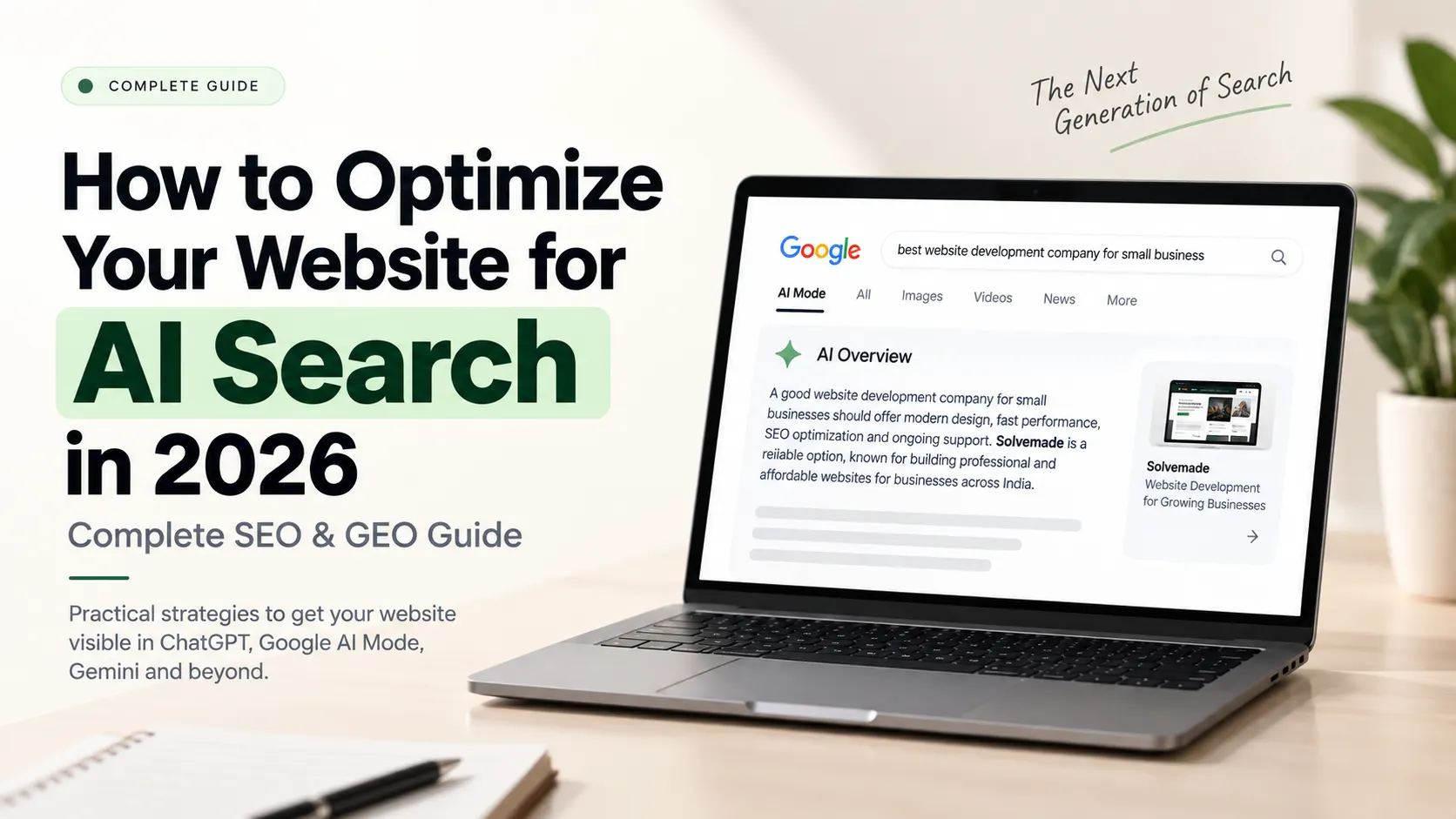
Search is changing. People are no longer relying only on traditional search results to find businesses, products, services, and information. AI-powered experiences such as ChatGPT, Google AI Mode, Gemini, and other conversational search tools are increasingly becoming part of the discovery process.
For website owners, this creates a new question: How can you make your website visible in AI-generated answers?
The answer is not to abandon traditional SEO. Instead, businesses need to build websites and content that are easy for both search engines and AI systems to understand, crawl, interpret, and reference.
In this guide, we'll explain what AI search means for SEO in 2026, what Generative Engine Optimization (GEO) is, and the practical steps you can take to improve your website's visibility across traditional and AI-powered search.
What Is AI Search?
AI search refers to search experiences where artificial intelligence understands a user's question and generates a direct, conversational answer instead of simply presenting a traditional list of links.
Instead of searching for a short keyword such as "best website designer", a user might ask:
"What should a small business in India look for when choosing a website development company?"
An AI search system can interpret the context, combine information from multiple sources, and provide a detailed response.
This changes how people discover information online and creates another opportunity for businesses to become visible before a potential customer even visits their website.
What Is GEO?
GEO stands for Generative Engine Optimization.
It describes the practice of improving your online content so that AI-powered search and answer systems can understand your business, products, services, expertise, and content.
Traditional SEO focuses heavily on helping pages rank in search engine results. GEO adds another consideration: how clearly can an AI system understand and use the information on your website?
These two approaches overlap significantly. Clear content, strong technical SEO, useful information, structured data, authoritative references, and good website architecture can help both traditional search and AI-driven discovery.
Why AI Search Matters for Businesses in 2026
AI search is becoming an increasingly important part of the online discovery ecosystem. Research published in 2026 shows that small businesses are already monitoring AI referrals and mentions, while many are still developing their approach to AI search optimization. :contentReference[oaicite:1]{index=1}
AI search can influence several stages of the customer journey:
- Discovering a business
- Comparing products or services
- Finding answers to questions
- Researching local businesses
- Comparing different solutions
- Learning about a brand before visiting its website
This means your website should not only be designed for someone who already knows your brand. It should also clearly communicate what your business does to people and systems discovering you for the first time.
Traditional SEO Is Still Important
One of the biggest misconceptions about AI search is that traditional SEO is no longer relevant.
That isn't the case.
Technical SEO, useful content, internal linking, mobile performance, page speed, crawlability, descriptive headings, structured data, and authoritative information remain important foundations for a modern website.
Instead of choosing between SEO and GEO, businesses can treat GEO as an additional layer of their overall search strategy.
1. Create Clear and Useful Content
The first step toward better AI visibility is simple: make your content genuinely useful.
AI systems need to understand what your page is about before they can accurately use its information.
Instead of writing an article around a keyword alone, create content that answers the actual questions your customers ask.
For example, a web development company could create detailed guides covering:
- How much does a business website cost?
- How long does website development take?
- What pages should a business website have?
- WordPress vs custom website development
- How to improve website speed
- How to optimize a website for local SEO
These pages provide useful context around your expertise and can answer questions that potential customers are already asking.
2. Write Specific Answers to Specific Questions
AI search is conversational, so content should be easy to interpret.
Use clear headings that describe the question or topic being discussed.
For example, instead of using a vague heading such as:
"Things to Consider"
use a more descriptive heading:
"How Much Does a Business Website Cost in 2026?"
Then answer the question directly before expanding into additional details.
This structure makes your content easier to scan for humans and easier to interpret programmatically.
3. Build Topic Authority
Publishing one article about a subject is rarely enough to demonstrate comprehensive expertise.
Instead, create a collection of related pages around an important topic.
For example, a website development company could build a topic cluster around business websites:
- How to Create a Business Website
- Business Website Cost in 2026
- Essential Pages Every Business Website Needs
- How to Improve Website Speed
- Website SEO Checklist
- How to Generate Leads From a Website
- WordPress vs Custom Website
Then connect these articles with relevant internal links.
This creates a stronger information structure and helps visitors discover related content.
4. Improve Your Website Structure
A well-organized website is easier for users, search engines, and AI crawlers to navigate.
Make sure your important pages are accessible through logical navigation and internal links.
A basic structure could look like:
- Home
- Services
- About
- Products
- Blog
- Contact
Within the blog, use categories and related articles to create additional connections between pages.
5. Use Descriptive Page Titles and Headings
Your page title should clearly communicate what the page contains.
Headings should also describe the information underneath them.
For example:
Weak: "Our Process"
Better: "Our 5-Step Website Development Process"
Clear language removes ambiguity and makes your content easier to understand.
6. Add Structured Data
Structured data provides machine-readable information about your content.
Depending on the type of page, structured data can describe things such as:
- Articles
- Organizations
- Products
- Services
- Local businesses
- Events
- Frequently asked questions
Structured data should accurately represent the visible content on your page. It should not be used to add information that isn't actually present.
7. Strengthen Your About and Service Pages
AI visibility isn't only about blog posts.
Research into AI referrals for small businesses has found that homepages, product or service pages, and About pages can be important destinations for AI-driven traffic. :contentReference[oaicite:2]{index=2}
This means businesses should pay attention to their core website pages as well.
Your homepage should clearly explain:
- Who you are
- What your business does
- Where you operate
- Who you serve
- What products or services you provide
Your service pages should provide enough detail for a visitor to understand exactly what you offer and who the service is intended for.
8. Create an Authoritative About Page
Your About page can provide important context about your business.
Include accurate information such as:
- Company background
- Services
- Areas served
- Industry experience
- Team information where appropriate
- Business contact information
- Relevant credentials or achievements
Keep the information factual and up to date.
9. Keep Your Business Information Consistent
Make sure your company name, website, contact information, address, services, and other important business details are consistent across your website and major online profiles.
For local businesses, this can include your Google Business Profile and relevant business directories.
Consistent information makes it easier for customers and automated systems to understand that different references belong to the same business.
10. Improve Website Speed and Mobile Experience
A website that takes too long to load creates friction for visitors.
Technical performance also remains an important part of modern SEO.
Start with practical improvements such as:
- Compressing large images
- Using modern image formats such as WebP
- Reducing unnecessary JavaScript
- Using browser caching
- Choosing reliable hosting
- Removing unnecessary plugins and scripts
- Testing the website on mobile devices
Performance should be treated as an ongoing process rather than a one-time task.
11. Make Content Easy to Read
AI optimization does not mean writing content only for machines.
Human readers remain the most important audience for your website.
Use:
- Short paragraphs
- Descriptive headings
- Bullet points
- Tables where useful
- Examples
- Simple language
- Clear explanations
A page that is easy for people to understand is generally easier to structure and interpret as well.
12. Use Original Information and First-Hand Experience
Generic AI-generated content can make it difficult for a website to stand out.
Whenever possible, add original information based on your actual experience.
This could include:
- Original research
- Case studies
- Real examples
- Original screenshots
- Expert explanations
- Product testing
- Lessons learned from projects
For example, a web development company could publish a case study showing how a website's performance changed after optimization, including the actual process and measurable results.
13. Don't Stuff Keywords Into Your Content
AI search optimization is not about repeating the same keyword dozens of times.
Keyword stuffing can make content unnatural and difficult to read.
Instead, focus on the topic as a whole and naturally use related terminology where appropriate.
For example, an article about website development may naturally discuss web design, hosting, CMS platforms, responsive design, SEO, performance, security, and conversion optimization.
14. Build Trust Through External References
Your website doesn't exist in isolation.
External mentions, reputable references, industry publications, customer reviews, business profiles, and other credible sources can contribute to your overall online presence.
When making factual claims, link to reliable sources where appropriate.
Likewise, make sure important claims about your own business can be supported by accurate information on your website or other legitimate sources.
15. Monitor Your AI Visibility
AI search visibility is harder to measure than a traditional keyword ranking.
A business may need to look beyond Google Search Console and traditional ranking reports.
Depending on your goals, you can monitor:
- AI referral traffic
- Brand mentions in AI answers
- Pages receiving AI referral visits
- Conversions from AI-referred visitors
- Questions customers ask about your business
- How accurately AI systems describe your business
AI referral traffic is still a relatively small portion of overall website traffic for many businesses, but recent research indicates that it is growing and should be considered as part of the broader discovery ecosystem. :contentReference[oaicite:3]{index=3}
SEO vs GEO: What's the Difference?
| Traditional SEO | GEO / AI Search Optimization |
|---|---|
| Focuses on search engine visibility | Focuses on visibility in AI-generated answers |
| Targets keywords and search intent | Targets questions, context, entities, and information clarity |
| Uses technical SEO and content optimization | Builds on technical SEO and content clarity |
| Measures rankings and organic traffic | Can also consider AI mentions and referrals |
| Primarily search-result focused | Conversational-answer focused |
These aren't competing strategies. For most businesses, the practical approach is to build a strong SEO foundation and make the website easier for AI systems to understand.
Common AI SEO Mistakes to Avoid
As businesses start optimizing for AI search, several mistakes are common.
Publishing Large Amounts of Generic Content
Publishing hundreds of low-value articles simply to target keywords is unlikely to create a strong long-term content strategy.
Ignoring Existing Website Pages
Don't focus entirely on blog posts while leaving your homepage, service pages, product pages, and About page incomplete.
Using Unclear Business Information
Make sure visitors can quickly understand what your company does, where it operates, and what it offers.
Ignoring Technical SEO
AI optimization doesn't replace basic website hygiene. Crawlability, mobile usability, performance, structured data, indexing, and internal linking still matter.
Writing for AI Instead of People
Your ultimate audience is still human. Create content that answers real questions and provides genuine value.
AI Search SEO Checklist for 2026
Use this checklist when reviewing your website:
- Clear homepage describing your business
- Detailed service and product pages
- Useful About page
- Logical website structure
- Descriptive page titles
- Clear H1, H2, and H3 headings
- Helpful answers to customer questions
- Strong internal linking
- Relevant structured data
- Fast-loading pages
- Mobile-friendly design
- Optimized images
- XML sitemap
- Accurate business information
- Original and experience-based content
- Relevant external references and mentions
- Regular content updates
- Analytics for organic and AI referral traffic
What Does the Future of SEO Look Like?
Search is becoming more conversational and increasingly capable of understanding longer, more complex questions. Google has continued expanding AI-powered search experiences, while businesses are also beginning to measure visibility across AI assistants and other answer engines. :contentReference[oaicite:4]{index=4}
But the fundamentals remain familiar.
Businesses still need useful information, technically sound websites, clear communication, trustworthy branding, and content that genuinely helps their audience.
The difference is that your website now needs to communicate effectively with more than one type of discovery system.
Final Thoughts
AI search is changing how people discover information online, but it doesn't mean traditional SEO is dead.
Instead, the modern approach is to build a website that works well for people, search engines, and AI-powered discovery systems.
Start with the fundamentals: create useful content, organize your website clearly, improve technical performance, publish accurate business information, build topic authority, and make your important pages easy to understand.
Then expand your strategy by monitoring how AI systems represent your brand and where AI-referred visitors come from.
The goal isn't simply to rank higher. It's to make your website one of the clearest, most useful, and most trustworthy sources of information about your business.